

Even today there are many unknowns when it comes to brain diseases such as Alzheimer’s, Parkinson’s, brain cancer, epilepsy and depression, and we still can’t fully comprehend these diseases that afflict so many in our society. The Brain Diseases Fund was set up to find answers to some of the most pressing questions in this area.
The Brain Diseases Fund promotes non-clinical basic research at the University of Zurich by supporting junior researchers. The UZH Foundation uses the funds to hand out annual prizes to young scientists for their outstanding contributions in the field of brain diseases. The UZH Award for Research in Brain Diseases was first awarded in 2006. The awarding of funds is overseen by an advisory board.
Much research is still needed on brain diseases such as Alzheimer’s and Parkinson’s.
Are you a PhD candidate looking to boost your research on brain diseases? Apply for the Brain Diseases Award and present your findings to our prestigious panel of experts. The UZH Foundation awards yearly prizes (of CHF 10,000 each) for outstanding research among all submissions. Here you can find informations on the rules for applicants. Please submit your application in full as a PDF file by 30 April to Prof. Dr. Amedeo Caflisch.
Rules for Applicants Brain Diseases Award
The advisory board is made up of the following members:
Mitochondrial dysfunction drives many neurodegenerative disorders. Restoration of mitochondrial function through healthy mitochondrial transplantation emerged as a promising therapeutic strategy. However, existing approaches are inefficient and cannot target mitochondria to specific cell types. To address this, we developed MitoCatch, a programmable platform based on protein binders to selectively deliver healthy mitochondria to disease-affected cell types. MitoCatch enabled efficient mitochondrial transfer across multiple recipient cell types. Delivered mitochondria were internalized, accessible to the cytosol, and functionally active. Targeted mitochondrial delivery enhanced cell survival and function in patient-derived neurons and in mice after optic nerve injury, establishing MitoCatch as a versatile strategy for cell-type-specific mitochondrial delivery and a potential therapeutic platform for neurodegenerative diseases.
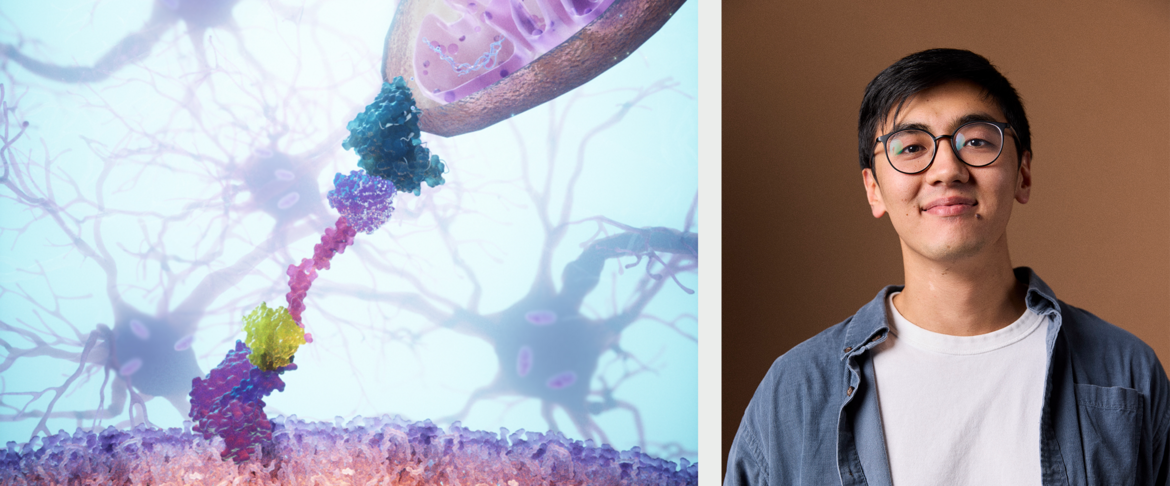
Bispecific binders target exogenous mitochondria to neurons (Credits: IOB)
Looking at the funds awarded to date, one pleasing feature can be noted: More than 20 of the 30 prizes for groundbreaking results in brain research have been awarded to female doctoral students. The Brain Diseases Award therefore not only recognizes great innovative potential, it also promotes women in science.