

How do culture, creativity, and communication arise in the animal kingdom—and what do they reveal about us humans? How can species and nature conservation, and the support of young researchers be approached together? And what clues about zoonotic diseases are hidden in the genomes of our closest relatives? UZH evolutionary anthropologist Kathelijne Koops is exploring these and other questions in the chimpanzee communities of the Mount Nimba region, a biodiversity hotspot protected as a UNESCO World Natural Heritage Site.
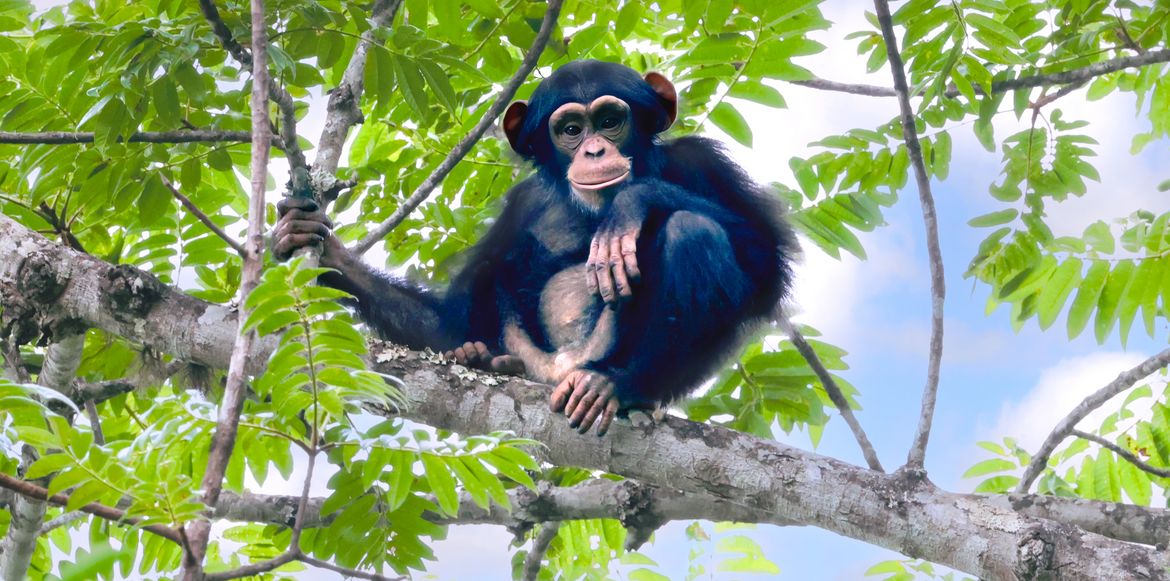
A young chimpanzee named “Katuo,” photographed by K. Koops on March 29, 2025, in the Nimba Mountains (Guinea, West Africa).
Worldwide, there are estimated to be only about 300,000 wild chimpanzees remaining. The situation is particularly critical in West Africa, where an estimated 50,000 individuals still live today. The main threats are habitat loss, illegal hunting, and the wildlife trade. Diseases and human-wildlife contact—mostly caused by shrinking habitats—also threaten the survival of these apes. A critically important population of 300 to 500 chimpanzees lives in the Mount Nimba region, on Guinea’s western border. The region is designated a UNESCO World Natural Heritage Site and serves as a vital refuge for these western chimpanzees in an area heavily impacted by human activity. Its conservation importance is particularly high, as this population contributes to the genetic diversity of its subspecies and preserves unique cultural behaviors whose loss would be irreversible.
Professor Kathelijne “Kat” Koops is leading a long-term research and conservation project dedicated to protecting West African chimpanzees and studying our closest living relatives. Together with her team in Guinea, the UZH professor is advancing her long-term studies on the behavior of the Nimba chimpanzees and advocating for the preservation of the ecosystem. Her research focuses on two neighboring chimpanzee communities on Mount Nimba. Professor Koops studies learned, group-specific behaviors, particularly tool use, foraging strategies, nest building, and communication. These observations provide important insights into how similar we humans are to our closest relatives, the primates. Until a few decades ago, the use of tools was thought to be unique to humans. However, scientific observations make it clear that chimpanzees deliberately create and use tools for foraging and feeding. During the research, the chimpanzees’ DNA is also analyzed. This provides valuable insights into genetic health aspects and the spread of zoonotic diseases among chimpanzees, other wild animals, and humans. This knowledge is applied within the context of One Health and is of direct relevance to global public health.
In parallel with data collection on the chimpanzees, the project documents human impacts, such as illegal hunting and slash-and-burn agriculture. The project team removes snare traps, thereby making a direct contribution to curbing these illegal practices. Professor Koops’s research also strengthens local communities. By training the next generation of scientists, the research team builds and expands local expertise, thereby ensuring that the knowledge gained is passed on.

“Chimpanzees are closer to us humans than any other species. Thanks to the research of K. Koops and her team, we are not only learning more about these primates threatened with extinction; we are also learning what it means to be human.”
Prof. Dr. Richard Wrangham, Senior Researcher in Biological Anthropology at Harvard University (emeritus) and founder of the Kibale Chimpanzee Project
The research team has a strong international network and is highly regarded. The Nimba Chimpanzee Project received international recognition in 2025 when it was awarded a DEI Prize by the International Primatological Society. The project carries on the legacy of renowned primatologists such as Dr. Jane Goodall, who had encouraged Prof. Koops to found the Nimba Chimpanzee Project.
In order to continue conducting high-quality research and education, a modest but fully functional research station is necessary. No public research funding is available for the construction of this research station; the project therefore relies on private third-party funding. This funding will be used, on the one hand, to conduct more in-depth analyses and evaluations, and on the other hand, to organize more training sessions and workshops.
With your donation, you will help gain valuable insights into primatology, human evolution, and One Health, while also helping to preserve threatened habitats.