

The Prof. Dr. Hans E. Schmid Fund supports young lecturers, private lecturers, and students in the field of organic chemistry at the University of Zurich. The prize consists of a scholarship of up to 50,000 Swiss francs. These scholarships are usually awarded every two years.
Named after the distinguished Swiss chemist Professor Dr. Hans Eduard Schmid, the fund is dedicated to fostering the development of young scientists at the University of Zurich. Professor Schmid made lasting contributions to organic chemistry through his work on the structural elucidation of natural substances, reaction mechanisms, and photochemistry.
He served the University of Zurich for decades and was appointed full professor and director of the Institute of Organic Chemistry in 1959, succeeding Paul Karrer. His international recognition includes the Centenary Prize of the Royal Society of Chemistry and an honorary doctorate from the University of Fribourg.
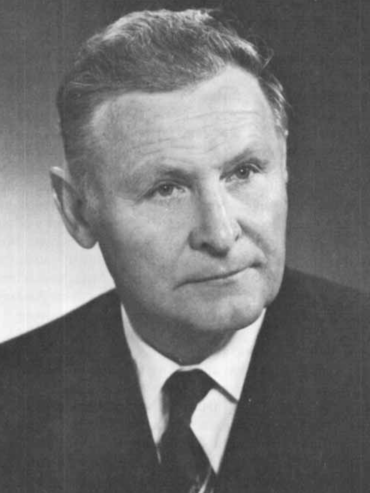
Prof. Dr. Hans E. Schmid
By supporting emerging talent in organic chemistry, the Prof. Dr. Hans E. Schmid Fund helps ensure the sustainable development of research and teaching at the Institute of Chemistry at the University of Zurich.
The call is now open, and researchers may apply immediately.
Download the terms and conditions here.
The deadline to submit applications is June 28, 2026. Complete applications should be submitted by the group leader in a single e-mail to pablo.riverafuentes@chem.uzh.ch.
The Advisory Board of the Prof. Dr. Hans E. Schmid Fund is composed of:
Prof. Dr. Pablo Rivera Fuentes, Institute of Chemistry, Chair
Prof. Dr. Owen Petchey, Member of the Dean’s Office, Faculty of Mathematics and Natural Sciences
Prof. Dr. Ricarda Törner, Institute of Chemistry
Microscopic electric fields play an important role in molecular interactions and chemical reactions, such as enzyme activity, catalysis, and at water-oil interfaces. However, measuring these fields in three dimensions at the molecular scale remains experimentally inaccessible. This project therefore explores the CF₂H group as a new molecular sensor for electric fields. It takes advantage of the fact that different C–H and C–F vibrations are oriented differently in space and are sensitive to their local electric environment. Using infrared spectroscopy, the project investigates how electric fields affect these vibrations and how their effects can be distinguished from other interactions, such as hydrogen bonding and dispersion forces. Building on this, multifunctional molecular sensors are being developed that can detect not only the strength and direction but also the temporal variation of electric fields. The method will ultimately be applied to electrochemical interfaces to investigate the spatially heterogeneous electric fields that arise there. The goal is to develop a versatile spectroscopic method for three-dimensional and time-resolved mapping of microscopic electric fields.
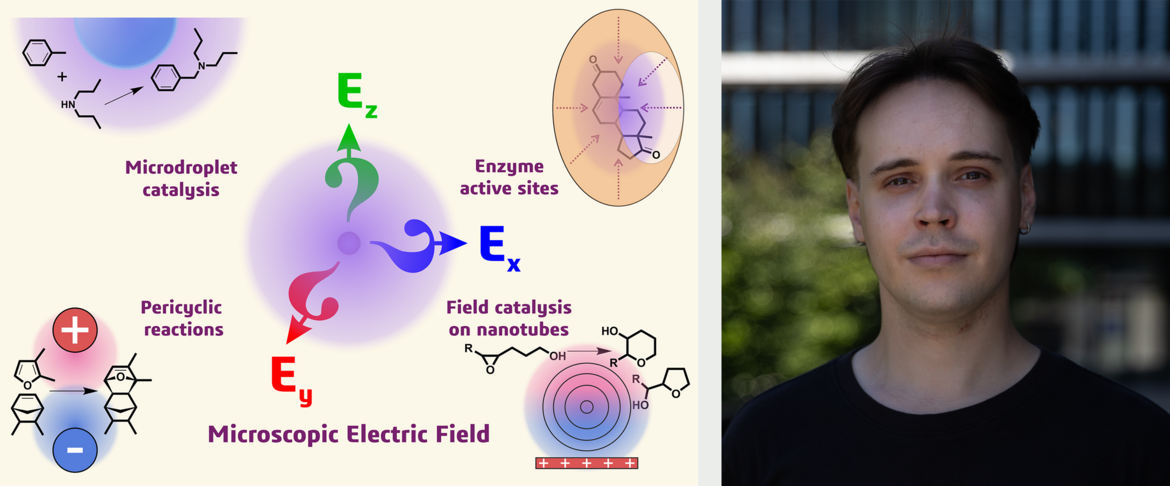
Molecular sensors aim to make microscopic electric fields visible.