

Gordon Freeman and Arlene Sharpe are the laureates of the inaugural Gretener-Thürlemann Prize awarded by the University of Zurich. Their research has been pivotal in developing immunotherapies to combat various forms of cancer.
by Adrian Ritter, freelance journalist
Great things can happen when the right minds come together. The story of Gordon Freeman and Arlene Sharpe is an excellent example of this adage. The two US researchers have been married since 1978 and in the 1980s began exploring one of the biggest questions in medicine: how do our bodies control the immune system, and how can this knowledge be harnessed for therapeutic benefit? The award-winning research conducted by Freeman and Sharpe has gone a long way towards answering these key questions.
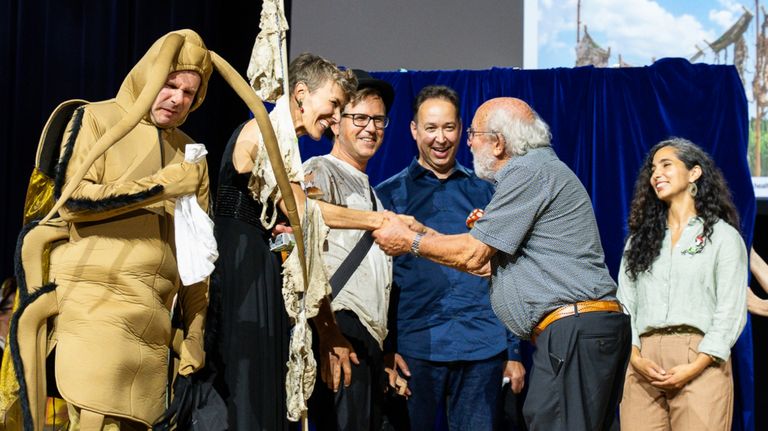
Yesterday, they received yet another honor for their work, the Gretener-Thürlemann Prize, awarded by the University of Zurich (UZH). The prize, which is endowed with CHF 500,000, recognizes researchers worldwide for outstanding achievements in medicine, chemistry and physics and was awarded for the first time this year. Gordon Freeman and Arlene Sharpe have been awarded the prize for their pioneering medical research into immune checkpoint inhibitors – therapies that have been instrumental in treating cancer.
“The Gretener-Thürlemann Prize reflects the wishes of the two founders, who wanted to support science beyond their lifetimes,” said Roger Dall'O, President of the Board of Trustees of the Gretener-Thürlemann Foundation. At the award ceremony, UZH President Michael Schaepman emphasized how Sharpe’s and Freeman’s research perfectly embodies innovation and impact.
First encounter during German lesson
Both developed an early enthusiasm for science. As a child, Arlene Sharpe would conduct hydroponics experiments in her living room, while Gordon Freeman joined his school’s science lab to learn about cells and bacteria. But their paths wouldn’t cross until much later, when both joined Harvard University – and took the same German class. At the time, neither of them was sure whether they really wanted to pursue biology or chemistry. But one thing was clear to both of them: “We wanted to read the works of important researchers in their original language – such as the works of important German chemists,” they recall.
After they had become a couple, they also followed similar academic paths, studying biochemistry and molecular biology and earning their PhDs in microbiology and molecular genetics. Arlene Sharpe then also went on to study medicine. Another shared experience would prove pivotal in shaping their professional lives: both lost their mothers to cancer. This would further motivate them to pursue careers in medical research.
And it was a good time to do so. It was the post-Sputnik era after 1957, when the Soviet Union took the lead in the Space Race with the launch of the first satellite. In response, over the decades that followed the US invested heavily in science education, research and technology. In 1971, the US government also declared the War on Cancer, a large-scale program that boosted cancer research nationally. Technological advances provided new insights into how tumors develop and how our immune system works. For example, scientists were now able to isolate genes and then to specifically “switch off” individual genes in animal models to study how this affected the immune system.
On the same path
Gordon Freeman and Arlene Sharpe have been at the forefront of applying these technologies. Their expertise and interests continue to complement each other perfectly. “Among other things, Arlene is very good at using genetic technologies such as CRISPR. My expertise includes producing antibodies,” says Freeman. Both lead their own long-standing research groups in Boston. Sharpe is a professor and chair of the Department of Immunology at Harvard Medical School, while Freeman is a professor of medicine at the Dana-Farber Cancer Institute at Harvard Medical School.
Their two labs are separated by a mere 10-minute walk across campus. “And there is a ping-ponging of knowledge between our research teams on the way to new discoveries,” says Sharpe. “We both have our own projects, but I estimate that they overlap by about 30 percent,” says Freeman. All their activities are guided by the overarching question of how the immune system is regulated. Their research network also spans numerous universities and university hospitals in Boston, the United States and institutions around the globe.
Among the outstanding achievements for which Arlene Sharpe and Gordon Freeman are now being honored is their discovery, from the 1990s onwards, of key signaling pathways that inhibit the immune response to tumors. A crucial element in this process is the immune system’s T cells, which have proteins on their surface that stimulate or inhibit their activity, including a protein called PD-1.
Freeman and Sharpe discovered that this protein can interact with the PD-L1 and PD-L2 proteins, which are produced, among others, by cancer cells. Cancer cells use these so-called inhibitors to curb the body’s immune response. But PD-L1 and PD-L2 are also produced by certain immune cells, allowing them to regulate T cell activity and ensure the immune response is properly balanced. If the response is too strong, it could also damage healthy tissue, but if it’s too weak, it may not be able to eliminate the diseased cells.
Developing antibodies
Around the year 2000, it became apparent that this new knowledge could also be used therapeutically. By blocking the inhibitors, the immune system can reactivate its response against cancer cells. Conversely, an overactive immune system can be reined in by boosting the inhibitors, for example to dampen autoimmune diseases or prevent the body from rejecting a new organ after a transplant. Researchers therefore set out to develop antibodies to influence the relevant proteins. In oncology, these so-called checkpoint inhibitors are now used in the treatment of more than 25 types of cancer.
“However, this immunotherapy is still far from effective in all patients,” says Freeman. He explains that the task is now to further decipher the signaling pathways of the immune system and discover additional genes and molecules that are involved in the process. The prospects are highly promising. “New technologies such as single-cell analysis and artificial intelligence allow us to understand the processes involved in cancer even better and develop novel therapies,” says Sharpe. And Freeman adds: “I am convinced that in the coming years, the success rate of immunotherapies and other applications, for example against autoimmune diseases, will continue to rise step by step. There are promising new approaches and numerous clinical trials are underway.”
Enthusiasm for basic research
Arlene Sharpe and Gordon Freeman continue to play a key role in this research. In the process, they not only offer hope to patients, but also inspire students and early-career researchers. “At the beginning, we didn't know where our research would lead us. Today, we see that basic research is leading to therapies we never would have dreamed of. That really motivates young researchers,” says Sharpe.
“We are delighted to receive this recognition on behalf of the work of our teams and all the researchers involved”, the two stated. “We are honored to be the first recipients of this important award.” As their shared journey of discovery continues, they demonstrate that medical breakthroughs are possible, driven by the simple desire to understand the inner workings of life.
More information
Gordon Freeman, PhD
Professor of Medicine at Dana-Farber Cancer Institute and Harvard Medical School
Arlene Sharpe, MD, PhD
Kolokotrones University Professor at Harvard University and Chair of the Department of Immunology at Harvard Medical School