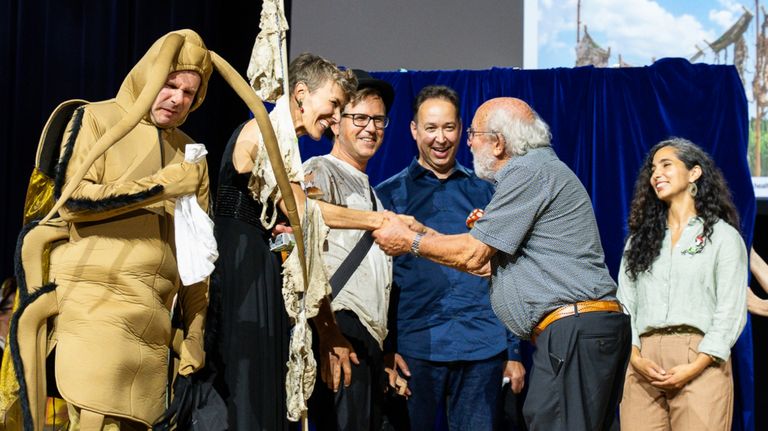

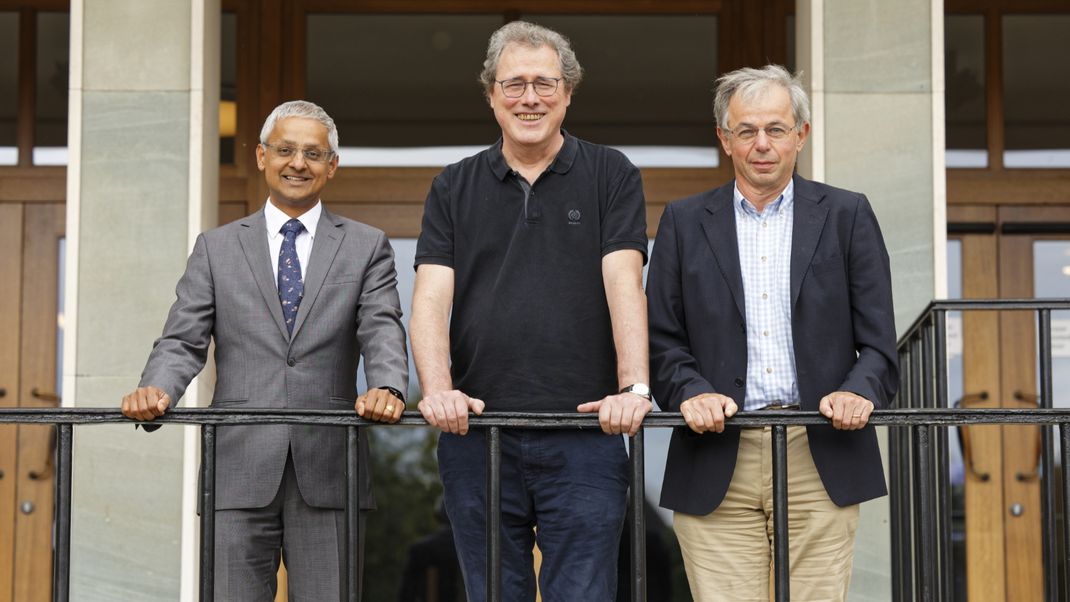
Shankar Balasubramanian, David Klenerman and Pascal Mayer will receive this year’s Gretener-Thürlemann Prize for the technology they developed, which allows millions of DNA fragments to be sequenced quickly, inexpensively and precisely. Their work has revolutionized genomics research.
Using so-called next-generation sequencing, which is now the standard in DNA sequencing, more than one million human genomes can be sequenced each year at a relatively low cost. In the past, this decoding process was extremely labor-intensive, time-consuming, and very expensive. The technology developed by Balasubramanian, Klenerman, and Mayer therefore represents a true democratization of DNA sequencing, making it accessible to scientists across many disciplines.
Analyzing DNA Fragments Simultaneously
In the 1990s, two young chemists, Shankar Balasubramanian and David Klenerman, at the University of Cambridge, sought to understand how a single enzyme could copy DNA. In the process, they came up with a completely new idea: Instead of reading a long DNA strand section by section, millions of short DNA fragments could be read simultaneously. The real innovation lies less in a new chemical method than in a completely new principle of parallel sequencing.
More than a billion DNA bases per run
Independently of their work, biophysicist Pascal Mayer developed a method in which each individual DNA molecule is first copied multiple times. Later, Shankar Balasubramanian and David Klenerman adopted the technology and integrated it into their sequencing system. This made DNA sequencing more precise, more cost-effective, and scalable for industrial applications.
In 2006, the “1G Genome Analyzer” was launched, the first platform capable of reading more than one billion DNA bases in a single run. Thus, a laboratory concept became a market-ready product, and the technology is now the world’s dominant method of next-generation sequencing, accounting for the vast majority of all genomic data generated.
Many different applications
However, the next-generation sequencing developed by Balasubramanian, Klenerman, and Mayer is far more than just a faster laboratory method. It has fundamentally transformed medicine and the biological sciences and is now used in various fields. Examples include personalized cancer medicine, the diagnosis of rare genetic diseases, prenatal diagnostics, and the fight against infectious diseases.
The rapid and cost-effective sequencing of genomes has greatly advanced numerous fields of biological research, ranging from evolutionary, plant, and environmental research to gene regulation, epigenetics, and single-cell genomics. The insights gained from this research form the basis for new drugs, improved diagnostic methods, and more resilient crop plants.
Shankar Balasubramanian, David Klenerman, and Pascal Mayer are being awarded the 2026 Gretener-Thürlemann Prize in Chemistry for the development of their groundbreaking sequencing method, which has decisively advanced the genomic revolution. The prize is awarded annually by the University of Zurich on behalf of the Gretener-Thürlemann Foundation for outstanding achievements in the fields of medicine, chemistry, or physics. The award ceremony will take place on November 5 at the University of Zurich.