
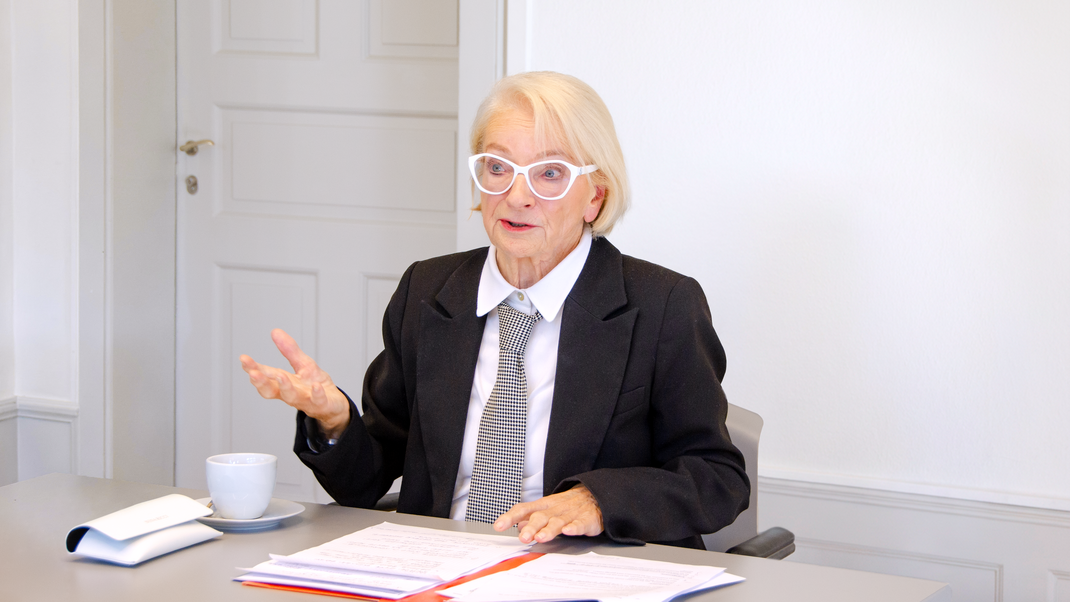
Monika Schleiss has always been determined to forge her own path – both in her career and in life. Health challenges eventually led her to a new passion: gender medicine. Through a bequest, she hopes to help ensure that medicine better understands and addresses the different needs of women and men.
Monika Schleiss’s day begins with a simple ritual: a cup of tea, an egg, and a conversation with her partner. Per haps it is this clarity that guided her early on to follow her own path. After attending the Lausanne Hotel Management School and studying at the University of St. Gallen, she entered the then-emerging field of strategic tourism management – becoming one of the first women to teach and lead in this area. At the time, resistance was part of everyday life. “I sometimes had to be faster and louder to be heard,” she recalls. Rather than being discouraged, she founded her own consulting firm, creating the space to develop ideas on her own terms. This mindset – taking initiative and assuming responsibility – has stayed with her ever since.
From Personal Experience to a Passion for Change
A health crisis brought gender medicine into focus. A damaged esophagus and a hip fracture confronted her with challenges that made her realize how, in medicine, little distinction is often made between women and men. “Why, as a woman, am I given the same medication as a man who is two meters tall?” she asked herself. This question became the starting point of an intensive journey of learning. She began to research, ask questions, and speak with experts. Through her family doctor and other physicians, she was introduced to the University of Zurich (UZH) and the UZH Foundation. “I was grateful to have someone who could guide me, listen to me, and explain the broader context.” She ultimately decided to revise her will and establish a bequest in support of gender medi cine. A decision that allows her commitment to extend beyond her lifetime.
“If I can play a small part in driving change, I will have achieved my goal.”
Time to Give Back
Her dedication goes beyond supporting research – it is also about raising awareness. “It’s about making things visible,” she says. Gender medicine is not about division or disadvantage, but about better understanding – benefiting women and men alike. “It was important to me to know where my money goes and that it can truly make a difference – so that research can continue to move forward.” For Monika Schleiss, one thing is clear: gender-specific differences must be more strongly considered – in everyday life, in education, and in research. Only by acknowledging these differences can therapies be truly effective for everyone. Although she does not see herself as a mentor, she has a clear message for those who want to make a difference: “Just do it. Be proactive. Every step counts.” This mindset continues to shape her actions today. “I’ve led a happy life despite challenges,” she says. “Now it’s time to give something back.” With her bequest in support of gender medicine, she hopes to create a lasting impact – even if she may not witness the results herself.
Spuren hinterlassen mit einem Legat
Would you like to include UZH in your estate planning? Discover the cause closest to your heart and support it with a bequest. Catja Frommen is available via e-mail or phone (+41 44 634 61 83) to answer your questions about possible forms of support in a no-obligation discussion.