

Shankar Balasubramanian, David Klenerman and Pascal Mayer will receive this year’s Gretener-Thürlemann Prize for the technology they developed, which allows millions of DNA fragments to be sequenced quickly, inexpensively and precisely. Their work has revolutionized genomics research.
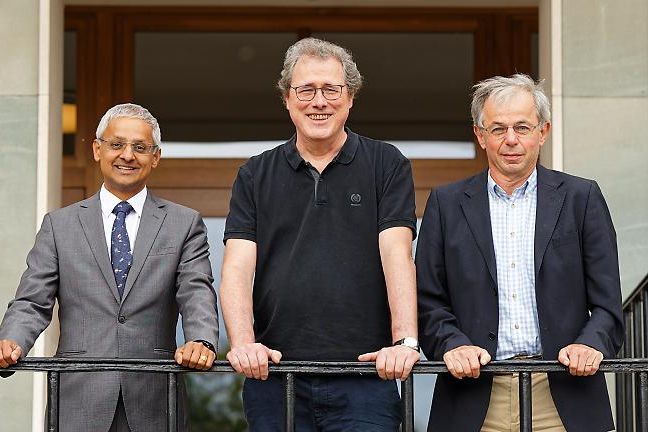
(from left to right) Gretener-Thürlemann Prize Awardees 2026 Shankar Balasubramanian, Pascal Mayer, David Klenerman.
by Thomas Gull, UZH
To decipher the first human genome, the Human Genome Project took 13 years, involved thousands of scientists in multiple laboratories and spent around USD 3 billion. The project, which ended in 2003, mapped and sequenced approximately 3 billion chemical base pairs of human DNA. Today, over a million human genomes may be sequenced per year for as little as USD 200 per person. This has been made possible by next-generation DNA sequencing, the current standard in use worldwide. “The technology developed by Balasubramanian, Klenerman and Mayer has given scientists and even non-geneticists worldwide the ability to sequence a human genome equivalent; thus, the technology has been truly democratized and made available to scientists across many fields,” writes John Aston, the Pro Vice-Chancellor for Research at the University of Cambridge, who nominated the three scientists for the Gretener-Thürlemann Prize. The University of Zurich awards the prize each year on behalf of the Gretener-Thürlemann Foundation to researchers for their outstanding achievements in medicine, chemistry or physics. The CHF 500,000 prize is to be given this year in the field of chemistry.
The award ceremony of the Gretener-Thürlemann Prize will take place in Zurich on Thursday, November 5, 2026.